Health Analysis
Understanding Your Ideal Weight: The Devine Formula Explained
April 18, 2026
6 min read
Nutrition Expert
Medical Contributor
Board Certified Physician
Verified Expert
Interactive Tools Mentioned
When trying to establish a healthy weight goal, many people guess based on what they weighed in high school or what they see on social media. In the medical and pharmaceutical industries, however, practitioners rely on standardized, peer-reviewed mathematical equations to determine target weights.
The most famous of these equations is the Devine Formula. Originally developed to compute dosage requirements for critical medications, it has become the standard baseline for calculating Ideal Body Weight (IBW).
The Origin of the Devine Formula
In 1974, Dr. Ben Devine published a study outlining a mathematical method to determine ideal body weight. The formula was created because many clinical drugs distribute poorly into fat tissue. To avoid overdosing patients, doctors needed a way to calculate a patient's weight based purely on their height and biological sex.
Over the decades, the formula transitioned from pharmacology to general fitness and public health, proving to be an excellent tool for estimating healthy baseline weights.
Pharmacokinetic Dosing Mechanics
Why does medical drug dosing rely on Ideal Body Weight? Different drugs distribute differently in body tissue based on their chemical structure:
* Hydrophilic Drugs (Water-soluble): These medications (such as gentamicin and tobramycin) distribute primarily into lean muscle and extracellular fluid. If a doctor doses a hydrophilic drug based on the *actual* weight of an obese patient, the concentration in blood plasma will reach toxic levels because the drug cannot dissolve into fat tissue.
* Lipophilic Drugs (Fat-soluble): These medications (such as anesthetics) dissolve easily into fat tissue, requiring different dosing guidelines.
For safety, doctors use the Devine formula to calculate the patient's baseline lean target before determining drug dosages.
The Math: How the Devine Formula Works
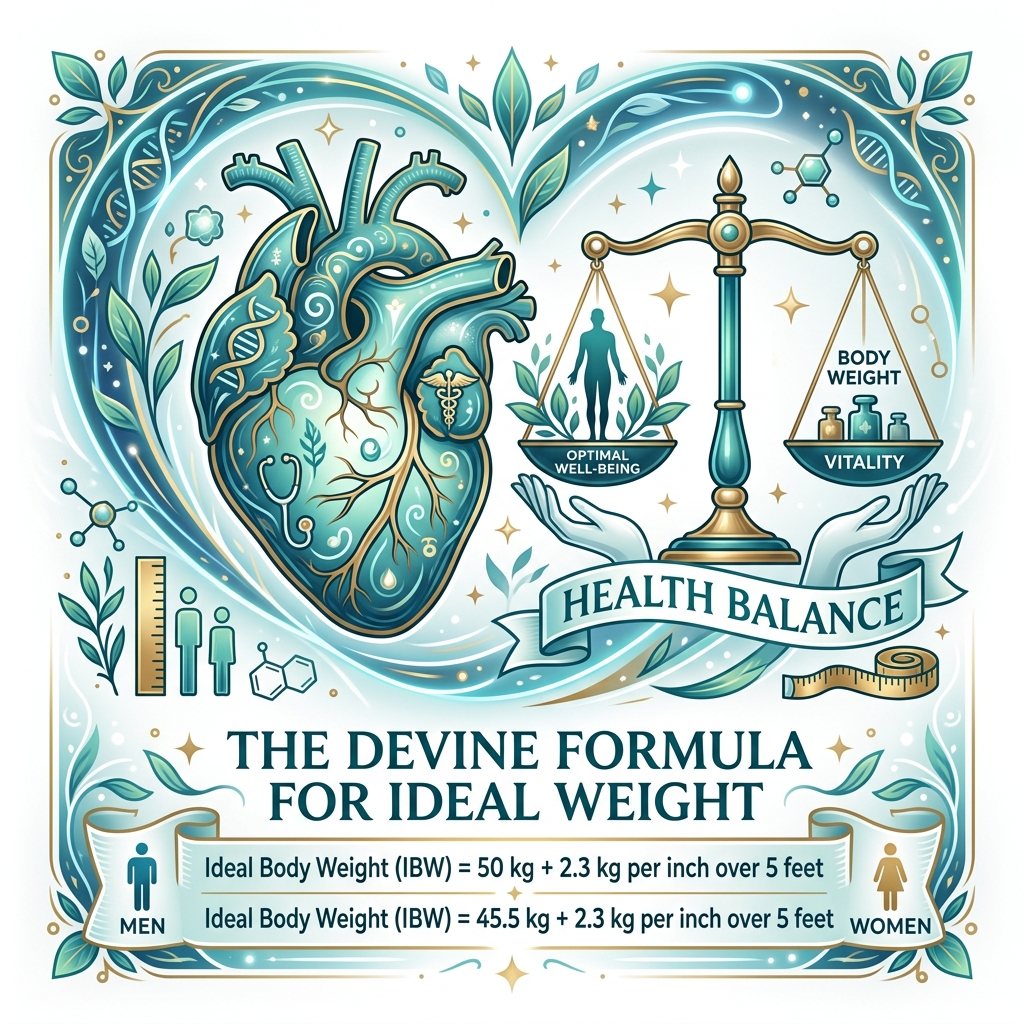
The Devine Formula uses a baseline height of 5 feet (60 inches or 152.4 cm) and adds a specific weight increment for every inch above that baseline.
* Men: IBW = 50.0 kg + 2.3 kg for each inch over 5 feet
* Women: IBW = 45.5 kg + 2.3 kg for each inch over 5 feet
For example, for a 5'10" (70 inches) male:
* Height over 5 feet: 10 inches
* Calculation: 50.0 kg + (2.3 kg × 10) = 73.0 kg (160.9 lbs)
You can compute your specific target range using our Ideal Weight Calculator.
Comparing the Weight Formulas
Over time, several equations have been introduced to refine Dr. Devine's baseline:
| Formula | Men (Bases & Increments) | Women (Bases & Increments) |
| :--- | :--- | :--- |
| Devine (1974) | 50.0 kg + 2.3 kg per inch | 45.5 kg + 2.3 kg per inch |
| Robinson (1983) | 52.0 kg + 1.9 kg per inch | 49.0 kg + 1.7 kg per inch |
| Miller (1983) | 56.2 kg + 1.41 kg per inch | 53.1 kg + 1.36 kg per inch |
| Hamwi (1964) | 48.0 kg + 2.7 kg per inch | 45.5 kg + 2.2 kg per inch |
Determining Skeletal Frame Size
To refine these formulas further, clinicians look at skeletal frame size using the wrist circumference ratio ($r$):
$$r = \frac{\text{Height (cm)}}{\text{Wrist Circumference (cm)}}$$
For Men:
* Small Frame: $r > 10.4$
* Medium Frame: $r = 9.6 \text{ to } 10.4$
* Large Frame: $r < 9.6$
For Women:
* Small Frame: $r > 11.0$
* Medium Frame: $r = 10.1 \text{ to } 11.0$
* Large Frame: $r < 10.1$
A large frame individual should adjust their calculated ideal body weight upwards by 10%, while a small-framed individual should adjust it downwards by 10%.
History of the Metropolitan Life Insurance Tables
Before mathematical formulas became standard, the Metropolitan Life Insurance Company established the first "Ideal Weight" tables in 1942 and 1959. By tracking actuarial data from millions of policyholders, they determined which weights were linked to the lowest rates of mortality.
However, these tables had methodological flaws. Heights were self-reported, individuals wore heavy shoes and clothes during measurements, and the tables did not account for differences between smokers and non-smokers (smokers were statistically thinner but had higher mortality rates). Modern formulas bypass these biases.
Limitations of Ideal Body Weight
It is crucial to recognize that the Devine Formula is a statistical model, not an absolute diagnosis. It does not account for:
1. Muscle Mass: An athlete with high muscle density will easily exceed their calculated ideal weight while remaining in excellent cardiovascular health.
2. Age: Healthy weight ranges naturally shift upward as we age to provide a reserve against bone density loss.
Using Ideal Weight to Guide Your Progress
To apply these numbers practically:
* Use the Devine range as a healthy target rather than an absolute rule.
* Pair your ideal weight targets with body composition checks (like waist circumference or body fat percentage).
* Focus on sustainable dietary habits and strength training to find a weight where you feel energetic and perform at your best.
Back to Knowledge Base
Share Article