Health Analysis
Beyond the Number: Understanding the Real Limitations of BMI
April 21, 2026
6 min read
Dr. Zohaib Ali
Medical Contributor
Board Certified Physician
Verified Expert
Interactive Tools Mentioned
Body Mass Index (BMI) has been the standard screening tool used by healthcare providers, insurers, and fitness professionals for over a century. Developed in the 1830s by Belgian statistician Adolphe Quetelet, it is a simple calculation: weight in kilograms divided by height in meters squared.
Despite its widespread clinical adoption, BMI is a blunt instrument. It frequently miscategorizes individuals, creating unnecessary anxiety or masking health risks. If you want to understand your true health profile, you must look beyond this single, oversimplified index.
The History: Quetelet's Quest for the "Average Man"
To understand the limitations of BMI, we must look at its history. Adolphe Quetelet did not develop the formula to measure personal health or obesity. Instead, he was a sociologist trying to define the mathematical characteristics of the "average man" (l'homme moyen) for population-level statistics.
Quetelet observed that, in adults, weight increases in proportion to the square of height. The equation was never designed to diagnose individual health conditions. In 1972, researcher Ancel Keys renamed Quetelet's index to "Body Mass Index" and proposed it as a simple population screening tool. Over time, it was adopted as an individual diagnostic standard, creating structural flaws in clinical assessments.
The Math: How BMI is Calculated
The standard BMI formula is:
* BMI = weight (kg) / [height (m)]²
Based on the score, individuals are sorted into four major classifications:
* Underweight: Below 18.5
* Normal Weight: 18.5 to 24.9
* Overweight: 25.0 to 29.9
* Obese: 30.0 or higher
While this classification system is simple, it ignores key aspects of human anatomy.
The Muscle Density Problem
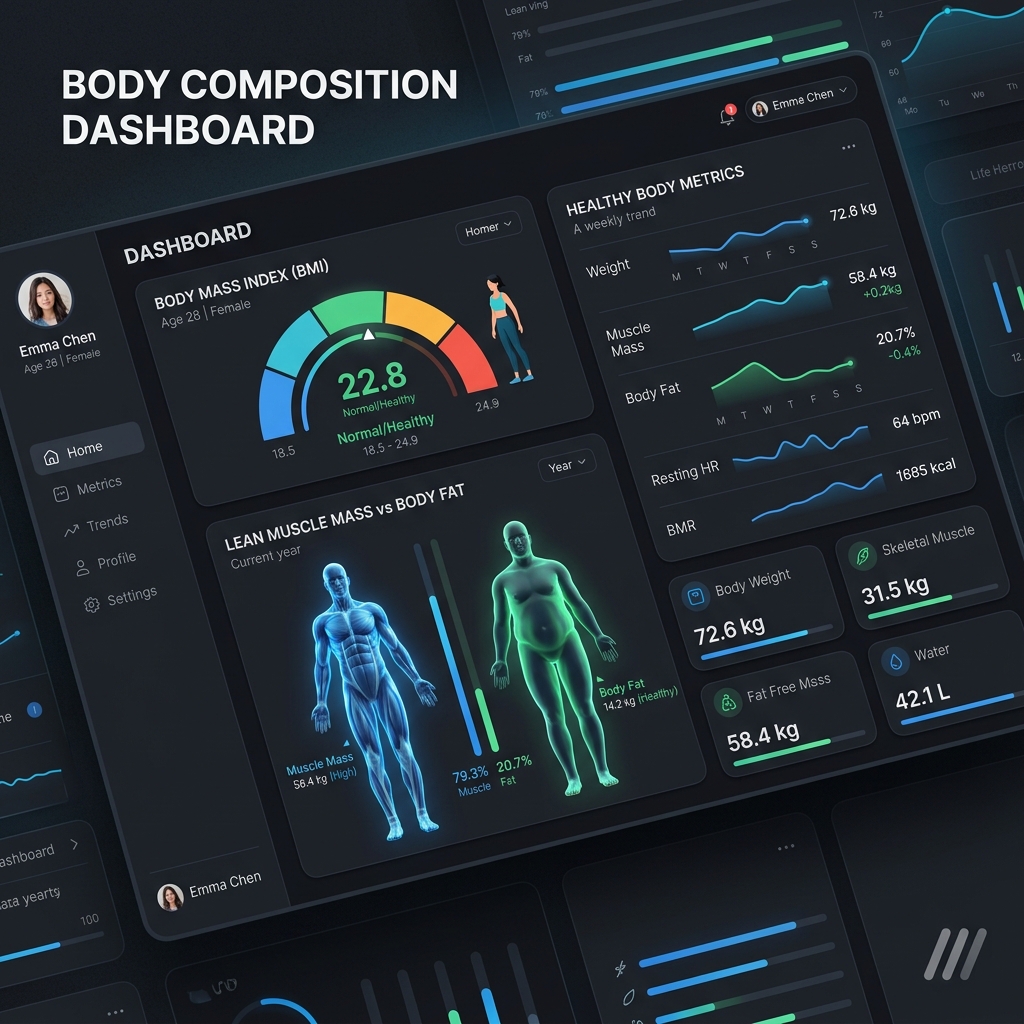
The biggest flaw in the BMI calculation is its inability to distinguish between fat tissue and lean muscle mass. Muscle is roughly 18% denser than fat tissue. An individual who is highly muscular will weigh significantly more than an inactive individual of the exact same height.
Because the formula only looks at total body weight, it frequently categorizes athletes, bodybuilders, and active individuals as "overweight" or "obese." For example, a professional rugby player or weightlifter with 8% body fat and massive muscle development can easily register a BMI of 28 or 30. In reality, their cardiovascular risk profile is excellent.
If you suspect muscle density is skewing your results, you should cross-reference your measurements using our Ideal Weight Calculator.
The "Skinny Fat" Phenomenon (Normal Weight Obesity)
Conversely, BMI can fail in the opposite direction. It can categorize a sedentary individual as "normal weight" even if they possess dangerously high levels of visceral fat and very low muscle mass.
This condition—often referred to clinically as normal weight obesity—carries many of the same cardiovascular and metabolic risks as clinical obesity. Since their weight falls in the normal range, these individuals are rarely prompted to make lifestyle changes, despite having high blood pressure, insulin resistance, or poor lipid profiles.
Ethnic Differences in BMI Validity
Clinical guidelines from the World Health Organization (WHO) show that the standard BMI thresholds are not universally applicable across different ethnicities:
* South Asian Populations: Visceral fat accumulation occurs at lower body weights. The WHO recommended threshold for "overweight" in South Asian individuals is lowered to 23.0, and the "obese" threshold is lowered to 25.0. South Asians have a higher genetic predisposition to insulin resistance and type 2 diabetes at lower BMI levels.
* Polynesian Populations: Generally possess a higher percentage of bone and muscle mass. A BMI of 26 or 27 in these populations is often completely normal and does not represent elevated health risks.
Why Fat Distribution Matters: WHR vs. BMI
Where your body stores fat is a much stronger predictor of health outcomes than how much total fat you carry.
* Subcutaneous Fat: Sits directly under the skin and is relatively harmless metabolically.
* Visceral Fat: Surrounds internal organs in the abdominal cavity. High levels of visceral fat are strongly linked to heart disease, type 2 diabetes, and stroke.
Because BMI does not account for fat distribution, medical researchers prefer the Waist-to-Hip Ratio (WHR). A waist-dominant distribution (an "apple" shape) represents a much higher health risk than a hip-dominant distribution (a "pear" shape). You can measure this distribution using our Waist-to-Hip Ratio (WHR) Calculator.
Systemic Inflammation: Visceral Fat as an Endocrine Organ
Visceral fat is not just inactive energy storage; it functions as an active endocrine organ. It secretes pro-inflammatory proteins called cytokines (such as tumor necrosis factor-alpha and interleukin-6) directly into the portal circulation.
These cytokines enter the portal vein and travel straight to the liver, driving hepatic insulin resistance, non-alcoholic fatty liver disease (NAFLD), and altered lipid metabolism. This systemic inflammation promotes coronary artery plaque accumulation, explaining why abdominal measurements are far more critical than overall weight.
Alternative Body Indices and Their Formulas
Because of these limitations, modern clinicians use alternative metrics:
1. Body Adiposity Index (BAI): Calculates adiposity using hip circumference and height, bypassing weight entirely.
$$\text{BAI} = \frac{\text{Hip Circumference (cm)}}{\text{Height (m)}^{1.5}} - 18$$
2. Fat-Free Mass Index (FFMI): Evaluates muscle mass relative to height.
$$\text{FFMI} = \frac{\text{Lean Body Mass (kg)}}{\text{Height (m)}^2}$$
3. Waist-to-Height Ratio (WHtR): A simple rule where your waist circumference should be less than half your height.
Age and Bone Density Limitations
As we age, our bone density and muscle mass naturally decline. A "normal" BMI in an elderly individual can often mask underlying frailty or osteopenia. A higher BMI is sometimes protective in older populations, a phenomenon known as the "obesity paradox," where moderately higher body weight provides a metabolic buffer during acute illnesses.
A Modern Framework for Health Tracking
Instead of relying solely on BMI, you should monitor a matrix of physical benchmarks:
1. BMI: Use it as a starting point, not the final word.
2. Waist-to-Hip Ratio: Track abdominal fat accumulation.
3. Strength Benchmarks: Keep track of lean muscle mass and physical strength.
4. Blood Biomarkers: Monitor blood pressure, fasting glucose, and cholesterol levels.
Back to Knowledge Base
Share Article